Tuesday, April 10, 2007

CWA: Corporate-owned Media


I love a panelist not afraid to insult his co-panelist’s employer. In a Tuesday panel entitled FOX in the Henhouse: Corporate-owned Media, that’s exactly what Jurek Martin, of the Financial Times, did when he slammed both the BBC World Service (TV) and CNN International for producing boring and repetitive newscasts that fail to adequately inform viewers about the day’s most important events. James Schiffman, chief copy editor at CNN International, took the criticism in stride, and his employer was quickly defended by the third panelist, Bruce Dold of the Chicago Tribune.

The panelists lamented the consolidation of corporate-owned media, but all three, and especially the newspaper men, seemed more concerned about the economic pressures being put on the traditional news models. Jurek Martin cited an “appalling lack” of international coverage in American newspapers and fumed over the decision of some large newspapers to scale back, or cut entirely, their foreign news bureaus. James Schiffman agreed, saying that in the era of globalization of economies, cultures and societies, and at a time when America is at war in the Middle East, it is more important than ever for Americans to be informed about world events.

The panelists seemed resigned to the reality of corporate consolidation in media ownership. Yes, yes, it is certainly alarming that a handful of mega-rich corporations own our favorite newspapers and TV channels, decreasing the diversity of viewpoints presented and boxing out dissenting voices. But what can a couple seasoned journalists and a copy editor do about it? The men on the panel seemed less concerned about their news agency’s owner and more concerned about maintaining the objective newsgathering and presentation that they've valued throughout their careers. But how can we retain objectivity when news agencies are limited in what they can cover for fear of offending the corporate bosses? How can the public trust journalists who represent a media company that is ultimately just interested in ratings and the bottom line?

In reference to the growing number of opinionated pundits like Lou Dobbs and Bill O’Reilly with their own shows on news networks like FOX and CNN, Bruce Dold of the Tribune said something I found quite interesting. Dold commented that American might be headed back to a 19th century model of news. Back in those days, there were many newspapers, each with a distinct viewpoint, and it was up to the reader to sift through the opinion and find the fact - if there was any to be found. Once newspapers saw they could do better financially by attracting a broader audience, the concept of objective reporting took root. Dold believes we may be headed back in the direction of a fragmented media with each news outlet pushing its own agenda. The days of objective reporting in the front sections and subjective opinion on the editorial pages may be waning as more news outlets abandon objectivity in favor of advocacy and agenda-setting.

Conference on World Affairs kicks off in Boulder


I suppose the CWA started yesterday, but for me, the conference kicked off this morning. I always look forward to this event, organized by CU each spring. I see it as a nice gesture for a university that all too often cuts corners in its offerings of internationally-focused curricula and major programs.

The first panel discussion I attended was held in the Boulder High School auditorium and was filled, for the most part, with lethargic-looking teens, clutching their Spanish textbooks and squirming under the scrutinizing eye of their teachers, determined to keep the students in line for the duration of the panel.

The title of the presentation was Latin America: Political Forecast. But I found the discussion not to be a prediction for Latin America's political future, but more of an opportunity for scholars to express their pro-North American vision for the region.

First, Vicki Huddleston, former U.S. diplomat, told the crowd that despite the fact that Fidel Castro is still alive, he is no longer in control of Cuba's affairs, and his country is due for political change. Despite what we may read in the alternative press about Cuba's universal health care and education systems, we mustn't believe the country has a free or open system. Is that it? Huddleston's observations were hardly fresh or insightful. The one interesting thing she did say referred to the elevated, nearly mythical status that Che Guevara, and to a lesser extent, Fidel Castro, have assumed in the minds of young people. She cautioned the audience against revering Che or Fidel too much (just as any American government lackey would), but nevertheless acknowledged the importance of these two men in the hearts of millions of people throughout Latin America. Che and Fidel were and are David to the United States' Goliath, and if Fidel lives until January of 2009, he will have outlasted 10 American presidents.

Judith Morrison, of the Inter-American Foundation, spoke about Venezuela and Brazil. She says she is concerned, as anyone who values democratic process should be, about the political situation in Venezuela under Hugo Chavez. Chavez has greatly overstepped his constitutional boundaries by declaring himself able to rule by decree, Morrison said. She added that the declining condition of basic infrastructure in Venezuela is unacceptable given the country's oil revenue and high global fuel prices.

On the other hand, Morrison praised Brazil for that country's investment in research, development and infrastructure. Her comments, while much better informed to be sure, sounded a bit like the rhetoric we heard from President Bush on his recent visit to Latin America. Her criticism of Venezuela and praise for Brazil was the line toed by Bush when he met with regional leaders in March.

What Morrison and the other panel members failed to address are the sky-rocketing corn prices in Mexico, which have hit the poorest people the hardest. Is is really a good idea to use a staple food crop for fuel when poor people who depend on corn for sustenance can't afford to eat as a result? (Think Bush's conversations with Brazil's government about the production of corn for ethanol).

And in regard to Venezuela, I'm tired of all the blind Chavez-bashing that doesn't even consider the changes he has implemented to benefit the poorest of the Venezuelan people. I am not trying to defend Chavez in his quest for ultra-concentrated power, but I would like to point out that millions of Venezuelans have benefited from health care, education and other social programs Chavez has implemented as a part of his Bolivarian Revolution.

Judith Morrison did mention, and I fully agree with her, that the U.S. has neglected Latin America, and as a result, we are losing status and credibility among not only the region's leaders, but among the people as well. What happens in Latin America affects us in the United States and vice versa. We ignore the region to our peril, as we have seen in recent years with the sharp increase in the number of undocumented immigrants unsafely crossing the U.S. border in search of work. As one of the panelists stated, we must make Latin American countries economically viable, for that is the only way to help the Latin American people and ensure U.S. national security at our southern border.

Friday, April 6, 2007

Googlezon video


This is a cool video hypothesizing about the future of news and the Internet. The predictions are more than a little disconcerting for journalists.

Thursday, April 5, 2007

We're ready already


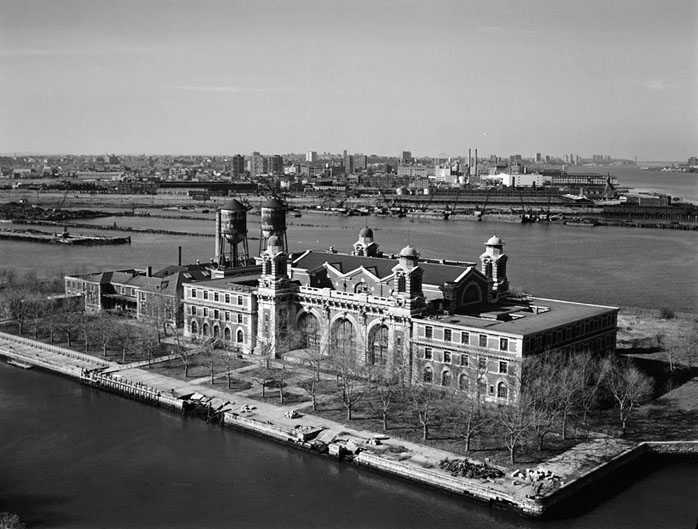
When I read about the Ferry Building on Ellis Island that recently opened to the public after being closed in 1954, I was reminded of our nation’s pressing need to enact another comprehensive immigration reform.

Ellis Island is the centerpiece of U.S. immigration history, and while parts of the island were opened to the public in 1990, the rest has been off limits to the curious since the 1950s. The Ferry Building was many immigrant newcomers’ final stop before heading to the mainland to begin their lives in America. It has been described as the “happiest” place on the island. Ellis Island was millions of immigrants’ gateway to a new life, with as many as 5,000 newcomers being processed each day in the early 1900s. The Ferry Building was where immigrants hitched a ride to shore after passing the legal and health inspections.

More than 12 million immigrants were processed at Ellis Island, and today there are about that many undocumented immigrants residing in the U.S. who can only dream of being legal residents. Our economy is obviously dependent on immigrant labor, yet the government doesn’t provide them with a legal avenue to enter the country. The result is our reality: a porous and dangerous border marked by ruthless smugglers and vigilante patrols, huge populations of settled illegal immigrants too fearful to make the trip home despite the seasonal nature of their work, and increasingly hateful rhetoric emanating from the mainstream press regarding the presence of undocumented immigrants.

We desperately need Congress to address this issue. President Bush, one year ago, put forward a sensible plan for reform that includes a guest worker program and a path to citizenship for some illegal immigrants. The Democratic takeover of the House and Senate was good news for those of us who support the president’s idea, but while some politicians have promised meaningful reform, absolutely nothing has been done about it.

Who knows how many more of the shuttered buildings of Ellis Island will be refurbished and opened to the public in the time it takes Congress to enact comprehensive immigration reform. We’re still waiting…

Monday, April 2, 2007

Denver's dark underbelly


One of the most highly regarded newspapers in the country recently ran a story on Denver, but it wasn’t complimentary. The New York Times published a piece on the rash of unsolved gun crimes that have gripped Denver in recent months. The story was no doubt inspired by the shocking assault on a group of college students from Kansas, who were shot even after surrendering their wallets to muggers at a light rail station in the Five Points neighborhood near downtown. One of the students remains in the hospital in serious condition.

When Darrent Williams, the Denver Bronco, was shot and killed through the window of his limousine a few months ago, the media spotlight again turned to Denver’s problem with gangs and guns. While the Williams murder commanded more attention than others, police have been fighting a burgeoning movement of gang violence that has claimed many lives, including several key witnesses who were slated to testify against gang members.

Javad Marshall-Fields and his fiancée, Vivian Wolfe, both 22, were shot dead in June 2005 just before Marshall-Fields was scheduled to testify in a murder trial. Two men have been convicted in the murders of Marshall-Fields and Wolfe and may face the death penalty. In another case of witness killing, Kalonniann Clark, 28, was murdered in front of her home last December after she refused to withdraw her name from the witness list in the attempted murder trial of suspected gang member Brian Kenneth Hicks, 27. Hicks tried to kill Clark herself in June 2005, and she was considered the prime witness for the prosecution.

The killing of witnesses poses a grave threat to our judicial system. If people are scared to testify, prosecutors won’t be able to build strong cases against gang members, who are notoriously hard to convict as it is.

Denver needs to save its reputation and quality of life by pumping more resources into combating gang activity and steering young people away from the lure of street life. Children who are at-risk of becoming involved in gangs should be our priority; public schools and state agencies must do everything possible to encourage these kids to seek education and employment by offering after-school and extra curricular activities, summer programs, academic tutoring and personal counseling.

The last thing we need


It's bad enough U.S. Rep. Tom Tancredo, R-Colo., keeps getting elected to Congress, embarrassing our state with his outrageously ignorant and racist comments, but the thought of Tancredo as president, or even as the Republican nominee, is truly terrifying.

Tancredo announced his presidential bid this morning on a radio talk show in Des Moines, Iowa. His candidacy will focus almost entirely on immigration issues. But what else would we expect from "Tancrazy?" His hatred for immigrants permeates every political move he makes.

Tancredo is the number one anti-illegal immigration crusader in Congress. He is the promoter of some of the most irrational immigration policy measures and the author of some of the most asinine comments ever heard on the subject.

Tancredo vehemently opposes any immigration reform plan that includes a path to citizenship for undocumented workers currently residing in the U.S. He strongly supports building a 2,000-mile fence along the U.S.-Mexico border, despite plenty of research indicating tighter border security only encourages permanent settlement in the U.S. by immigrants who would otherwise opt to return home to Mexico. This is a perfect example of how shallow Tancredo's understanding is of the only issue he concerns himself with.

Let's take a moment to recall some of Tancredo's most shining public statements. There was the time he suggested bombing the Muslim holy city of Mecca in response to terrorist attacks. Oh, and the time he compared Miami to a Third World country, prompting outrage among citizens and admonishment from Governor Jeb Bush. And no one can forget Tancredo's criticism of the memorial plans for flight 93, which crashed on Sept. 11, 2001, in Pennsylvania. Tancredo balked at the Interior Department's plan to create a memorial in the shape of a crescent.

"The appropriateness of the design has been questioned by many people because of the crescent’s prominent use as a symbol in Islam...It has raised questions in some circles about whether the design, if constructed, will in fact make the memorial a tribute to the hijackers rather than the victims..." Tancredo wrote in a letter to the Department of Interior. (Read the whole letter here).

Thankfully, in a pool of well-rounded Republican candidates, Tancredo probably doesn't have a snowball's chance of securing the nomination. Thank goodness, for he would surely be the worst president ever; his legacy would be to replace our tolerance with bigotry, and our hope with fear and suspicion.

Thursday, March 22, 2007

Supreme Court debates Bong Hits 4 Jesus


When Joseph Frederick stood across the street from his Juneau, Alaska, high school displaying a 14-foot banner reading "Bong Hits 4 Jesus," the principal responded by suspending him. He appealed, and the case got all the way to the high court this week.

By all reports, the justices had a lively debate about whether the banner constitutes a pro-drug message. If they decide Frederick's banner was indeed advocating drug use, the Court will likely side with the principal. But Frederick has contended from the beginning that his message is a valid expression of his First Amendment rights, and his lawyer is trying to keep the case about free speech rather than drugs.

Kenneth Starr, the attorney arguing the side of the high school principal, told the justices "Bong Hits 4 Jesus" is a blatantly pro-drug message, and it is perfectly appropriate for school officials to curtail such kinds of student speech. Starr and the Bush administration have asked the Court to consider making a broad ruling to give public schools authority to limit any student speech with which they disagree.

Luckily, the justices didn't like that idea much. It doesn't seem right that young people should have to check their speech rights at the door of their schools. Controlling speech that advocates drugs is one thing, but schools should mirror democratic societies and allow students to explore and exercise their First Amendment rights to free speech and assembly.

The court is expected to return a decision in the Frederick case by July.